


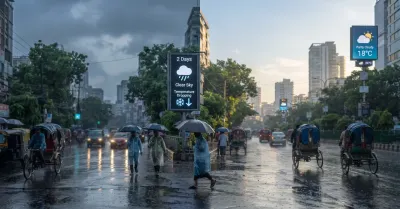
Air quality in Dhaka remained unhealthy on Wednesday, with the capital ranking fourth among the world’s most polluted cities with an Air Quality Index (AQI) score of 182.
Pollution levels in Dhaka typically rise during winter, raising concerns about the health risks faced by residents as the season sets in.
According to data released by Swiss air quality monitoring organisation IQAir, the ranking was recorded at 1:00pm Bangladesh time on November 25.
Several areas of the capital recorded very unhealthy air quality. Progoti Sarani in Badda was the most polluted location in Dhaka, with an AQI score of 213.
Becharam Deuri in Old Dhaka also recorded very unhealthy air, with a score of 202.
Pakistan’s Lahore ranked first among the world’s most polluted cities, with an AQI score of 265.
Mongolia’s capital Ulaanbaatar stood second with a score of 196, while Karachi, Pakistan, ranked third with 186. Dhaka followed in fourth place with 182.
IQAir provides real-time air quality information, helping people understand pollution levels in cities around the world.
According to IQAir’s air quality classification, an AQI score of 0–50 indicates good air quality, while 51–100 is considered moderate.
A score between 101 and 150 is classified as unhealthy for sensitive groups, including children, older people and individuals with existing health conditions.
Scores ranging from 151 to 200 indicate unhealthy air quality. A score between 201 and 300 is considered very unhealthy, while anything above 300 falls into the hazardous category.
With Dhaka recording an AQI score of 182, the capital's air quality remained in the unhealthy range, while some neighbourhoods experienced even more severe pollution.



Comments
No comments yet. Be the first to write one.
Leave a comment